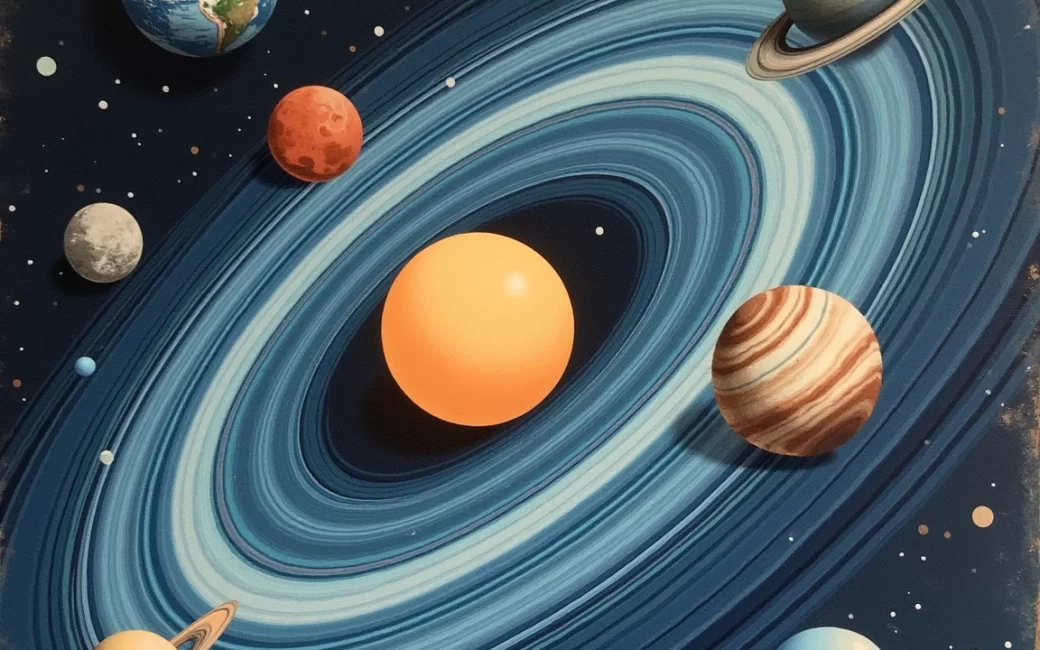
A collapsing cloud of gas and dust forms the Sun
The solar system began as a cloud of gas and dust that collapsed under its own gravity, with most of the material falling toward the centre to ignite the Sun. The Center for Astrophysics describes this process as the starting point for everything that followed: a spinning disk of leftover material flattened around the young Sun, and within that disk, particles collided and stuck together, building up into the planets, moons, asteroids and comets we see today.
Where a particle ended up in that disk determined what it became. Close to the Sun, heat drove off lighter gases, leaving behind rocky material that formed the dense inner planets — Mercury, Venus, Earth and Mars. Farther out, past what's sometimes called the frost line, ices and gases survived, building the bulk that let Jupiter, Saturn, Uranus and Neptune grow into gas and ice giants. The Sun's gravity then locked all of this into orbits, some circular and stable, others eccentric and far-flung.
Not everything formed a planet. Asteroids and comets are the leftovers — material that never got swept up — and because they've gone largely unaltered since formation, they preserve a record of the solar system's original chemistry that the planets themselves no longer show, since planetary interiors have been reshaped by heat, pressure and geological activity ever since.
Telescopes find many round bodies beyond Neptune similar to Pluto
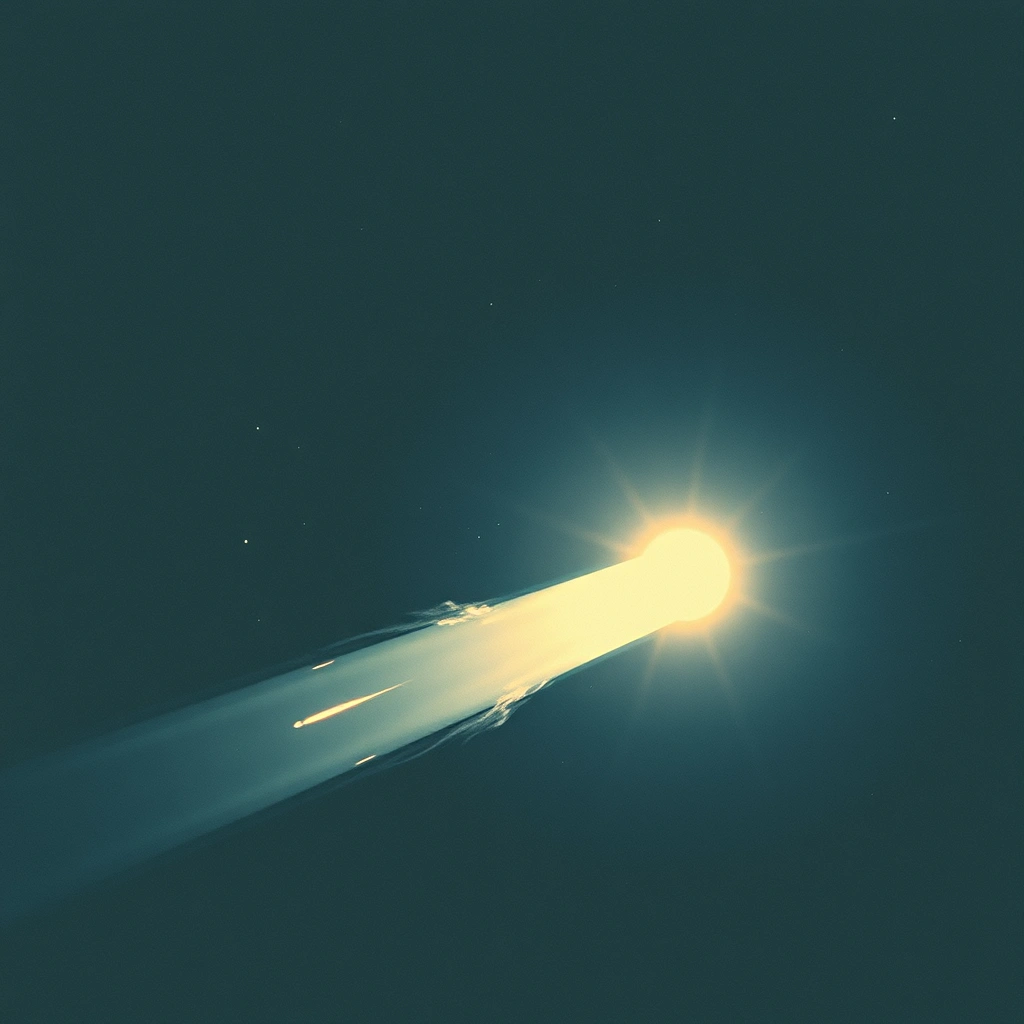
Nine planets became eight because telescope surveys kept finding more Pluto-sized objects beyond Neptune, and calling all of them planets would have pushed the count into the dozens rather than settling on nine. As observatories improved through the 1990s and 2000s, astronomers identified a population of icy, round bodies in the Kuiper Belt — some close to Pluto's size, and one, Eris, thought at the time to be even larger.
That discovery forced a decision: either keep adding planets indefinitely, or define the term precisely enough to draw a line. In 2006 the International Astronomical Union adopted a formal definition, described on the Smithsonian National Air and Space Museum's solar system pages, requiring a planet to orbit the Sun, be massive enough for its own gravity to pull it into a round shape, and have cleared its orbital neighbourhood of other debris.
Pluto fails the third test — it shares its orbital region with other Kuiper Belt objects and hasn't cleared them out — so it was reclassified as a dwarf planet rather than a planet. The same reasoning applies to Ceres, the largest object in the asteroid belt, and to Eris itself: both are round, both orbit the Sun, and neither has cleared its neighbourhood, so both are dwarf planets under the same criteria. That reclassification is why the solar system now has eight planets rather than nine, and why the number is unlikely to grow again without another vote on the definition itself.
An icy body from the Kuiper Belt or Oort Cloud is nudged onto an orbit that brings it near the Sun
A comet starts as an inactive chunk of ice and dust orbiting far from the Sun, until a gravitational nudge — often from a passing star or another body — shifts its orbit inward. As it approaches the Sun, solar heating begins to vaporise the ices on its surface, releasing gas and dust that the Sun's radiation and solar wind push outward into a glowing coma and a tail. That tail, described by NASA's solar system exploration overview, always points away from the Sun regardless of the comet's direction of travel, because it's shaped by radiation pressure rather than motion.
This is the clearest way to separate comets from asteroids: origin and behaviour, not appearance.
- Asteroids formed closer to the Sun, are made mostly of rock or metal, and stay solid and inert even at their closest approach.
- Comets formed farther out, in the Kuiper Belt or the more distant Oort Cloud, and are rich in ices that vaporise when warmed.
- Only comets develop a visible coma and tail; an asteroid passing the same distance from the Sun shows no such activity because it has little or no ice left to release.
Once a comet's orbit repeatedly brings it close to the Sun, it gradually loses material with each pass, which is why some comets fade or break apart over many orbits while the rocky asteroids in the inner system remain largely unchanged.
A planet's mass and radius set its surface gravity
Surface gravity depends on how much mass a planet has and how far that mass is from the surface, which is why a smaller, less massive world like Mars pulls on objects more weakly than Earth does. Because weight is just the force of gravity acting on a given mass, the same person weighs less on Mars simply because the planet's gravity is weaker, not because their mass has changed.
To convert a weight from Earth to Mars, multiply by the ratio of the two surface gravities. Mars's surface gravity is lower than Earth's, so a 150-pound person on Earth would weigh roughly 57 pounds on Mars — Earth weight multiplied by that ratio. The same arithmetic works for any mass or any planet, provided the surface gravity figure is right: take the Earth weight, multiply by (Mars gravity ÷ Earth gravity), and the result is the equivalent weight on Mars.
Surface gravity does more than change how much a scale reads. A planet's ability to hold onto an atmosphere depends partly on how strongly it can gravitationally retain gas molecules over billions of years. Mars's weak pull is one reason it has lost most of its atmosphere over time, leaving it thin and cold today, and it's a key part of why Mars is discussed so often in questions about habitability — a planet's gravity, not just its distance from the Sun, shapes whether it can keep the air it started with.
Solar System
The solar system is the Sun together with everything gravitationally bound to it — eight planets, the dwarf planets, hundreds of moons, and countless smaller bodies including asteroids and comets. The Smithsonian and NASA both describe it this way: not a fixed list of objects, but everything held in orbit by the Sun's gravity, out to the point where the Sun's influence gives way to interstellar space.
That outer edge isn't a single crisp boundary. The heliosphere — the bubble of solar wind and magnetic field the Sun projects into space — marks where solar influence physically ends, but the Kuiper Belt extends to a similar rough distance and the Oort Cloud, a spherical shell of icy bodies loosely bound by the Sun's gravity, is thought to reach far beyond that. Because these three concepts answer different questions — plasma physics, small-body population, gravitational reach — none of them alone is "the edge," and sources vary in which one they emphasise.
Dwarf planet
A dwarf planet orbits the Sun and is massive enough to be rounded by its own gravity, but has not cleared its orbital neighbourhood of other debris — the third of the IAU's 2006 criteria that a full planet must meet. Pluto, Eris and Ceres are the most commonly cited examples, each round and orbiting the Sun, but each sharing its orbital region with other bodies rather than dominating it gravitationally.
This is a narrower category than "small solar system body," which covers everything else too small or irregular to be rounded by its own gravity — most asteroids and comets fall there instead.
Asteroid
An asteroid is a rocky, sometimes metallic body left over from the solar system's formation, most commonly found in the asteroid belt between Mars and Jupiter. Unlike comets, asteroids formed in the warmer inner disk where ices could not survive, so they remain solid and largely inert even when their orbits bring them close to the Sun, as NASA's overview of solar system bodies notes.
Asteroids range enormously in size, from boulders to Ceres, the largest object in the belt and itself reclassified as a dwarf planet. Most, though, are simply irregular chunks of rock too small to be pulled into a round shape by their own gravity.
Comet
A comet is an icy body, rich in frozen gases and dust, that develops a glowing coma and tail once solar heating begins to vaporise its surface as it nears the Sun. Comets originate far from the inner solar system — in the Kuiper Belt or the more distant Oort Cloud — and only become active and visible on the orbits that carry them inward.
Because each close pass to the Sun burns off some of a comet's ice, repeated orbits gradually deplete it, which is why comet activity tends to fade over many returns rather than staying constant.
Earth
Earth serves as the reference point for nearly every comparison made about other planets — its size, its surface gravity, its atmosphere, and the fact that it hosts life. When sources describe Mars's weaker gravity, a moon's thin atmosphere, or an exoplanet's potential habitability, they're measuring against Earth's own mass, radius and atmospheric composition, as laid out in overviews from both NASA and the Smithsonian.
That reference role is also why Earth sits at the centre of the habitability question elsewhere in this piece: any claim that another world could support life is, implicitly, a comparison to conditions here.
Mars
Mars is the most-visited planet beyond Earth and the focus of most surface-gravity and habitability questions, partly because it's close enough for repeated robotic missions and partly because its thin atmosphere and weak gravity make it a useful case study in what a planet needs to remain habitable. Its surface gravity is roughly a third of Earth's, which is the basis for the weight-conversion arithmetic covered above, and its atmosphere — thin, mostly carbon dioxide — is often attributed to that same weak gravitational hold combined with the loss of its global magnetic field, as summarised in NASA's solar system materials.
Mars's accessibility has made it the most thoroughly explored planet in the solar system aside from Earth, and much of what's known about planetary atmosphere loss and past habitability comes from missions specifically targeting it.
Are there 9 or 8 planets in the solar system?
There are eight planets, not nine. The change happened in 2006, when the International Astronomical Union adopted a formal definition of "planet" requiring a body to orbit the Sun, be rounded by its own gravity, and have cleared its orbital neighbourhood of other debris — a test Pluto fails, since it shares the Kuiper Belt with other similarly sized bodies. Pluto was reclassified as a dwarf planet, and the same three-part test is what keeps other round Kuiper Belt and asteroid-belt objects, like Eris and Ceres, out of the planet category too.
What will happen on March 23, 2178?
Nothing dramatic is expected on that date specifically — it's one of many dates that circulate online as a rare planetary alignment, typically because several planets appear loosely grouped in the sky as seen from Earth. Planetary alignments of this kind are calculated using known orbital periods: astronomers project each planet's position forward using its orbital speed and distance from the Sun, then flag dates when several planets fall within a narrow span of sky at once.
These alignments are visual rather than physical — the planets don't move any closer together or exert any unusual gravitational effect on Earth, since their actual distances from each other change very little. What varies is only the apparent clustering as seen from one viewing point, which is why "rare alignment" dates make for striking headlines but don't correspond to any measurable event beyond an unusual sky view, and why such dates should be checked against a specific orbital calculation rather than repeated as fact.
Will we find aliens in our lifetime?
Nobody currently knows, and no confirmed evidence of life beyond Earth exists yet, but the search has a fairly specific target: chemical or physical signs — called biosignatures — that are hard to explain without biological activity, such as certain atmospheric gas combinations or the persistent recycling of a gas that would otherwise disappear. Missions described on NASA's solar system pages focus this search on a handful of promising locations: the subsurface oceans of icy moons like Europa and Enceladus, and the atmospheres and past-water evidence on Mars.
Finding that evidence would mean detecting a signal consistent with biology and ruling out non-biological explanations — a high bar that current instruments are only partly equipped to clear. Whether that happens within any particular lifetime depends entirely on which missions fly, what their instruments can resolve, and whether the first hints of a biosignature hold up once other explanations are tested.
Pick a planet, an asteroid, or a comet mentioned here and work the numbers on it — its own surface gravity, its own orbital period, its own distance from the Sun — the same way this piece worked Mars.