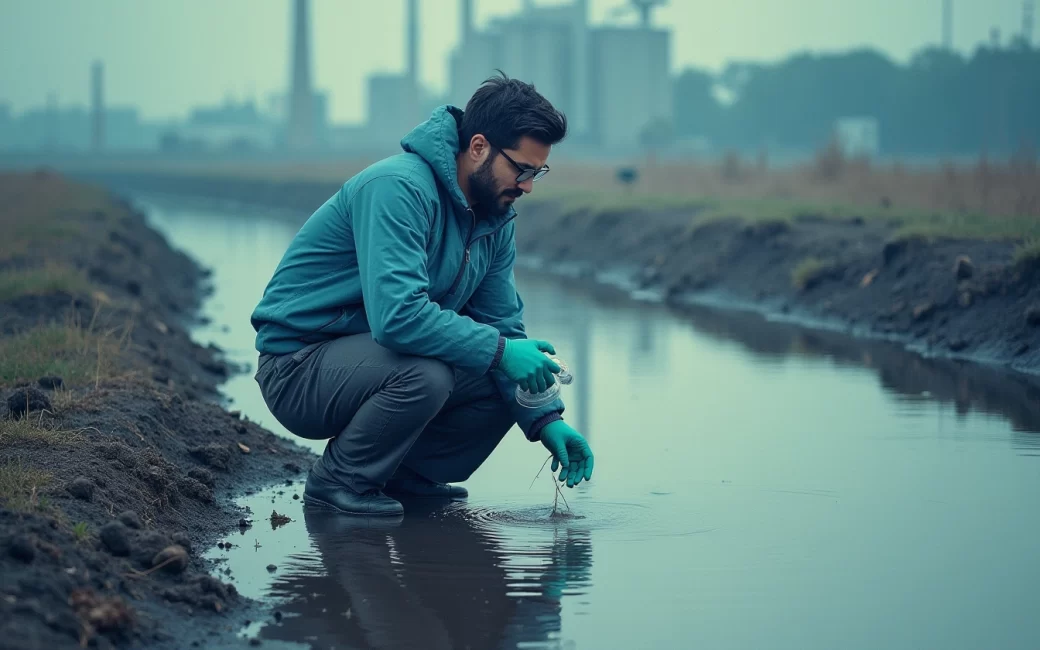
Human activity draws on soil, water and other natural resources

Every environmental problem traceable in the research literature starts with the same transaction: people draw on soil, water, timber, minerals or fossil fuel stocks faster than those stocks replenish. That draw-down is the starting point of environmental science rather than an afterthought to it — the field exists to trace what happens between the extraction and the consequence.
The path runs in a consistent order:
- Extraction and emission — agriculture, industry and energy use pull resources from soil and water systems and return waste heat, carbon dioxide and pollutants to them.
- System-level pressure — those emissions and withdrawals accumulate into drivers such as climate change, and into localised stress on ecosystems — the specific communities of organisms and physical conditions that absorb the pressure first.
- Measurable decline — soil and water quality indicators (nutrient levels, contaminant load, acidity, turbidity) shift in response, and these shifts are what gets measured, not the pressure itself.
- Monitoring and assessment — researchers and agencies track those indicators over time and attribute change to a cause, which is the work environmental science as a discipline is built to do.
- Policy response — periodic assessments compile the monitoring data into a status report that governments and institutions can act on.
That last step has a concrete example: the Global Environment Outlook is the kind of periodic assessment that synthesises environmental monitoring data into a status report intended to inform policy, rather than simply describing a problem in isolation. The point of walking the chain this way is that "soil degradation" or "water stress" are never freestanding facts — they are the visible middle of a longer process that starts with resource use and ends, if it ends well, in a regulatory or management decision. A researcher who studies only the indicator without the driver, or only the driver without the policy mechanism, is doing a fragment of environmental science, not the whole of it.
This is also why the field sits institutionally where it does — bodies like the European Geosciences Union's policy programme exist specifically to carry evidence from the monitoring stage into the policy stage, because that handoff does not happen automatically.
Pressure to publish meets journals with weak or absent peer review
A climate claim is only as good as the review process behind the paper that made it, and that process is not uniform across journals bearing scientific-sounding names. Academic incentives reward publication volume, and that pressure has created an opening for journals that carry little or no genuine peer review while presenting themselves as legitimate scientific venues.
Reporting in the Guardian's environment coverage has described how this "murky world" of science journals functions as a channel for climate misinformation: flawed or contrarian papers appear in venues that look credible on the surface, get indexed, get cited by advocacy groups and commentators as though they carried the same weight as reviewed findings, and from there seed public claims that circulate well past the point where anyone checks the original source. The Guardian's account of this problem frames it as a deliberate exploitation of the gap between "published" and "peer reviewed" — two words the public tends to treat as synonyms.
That gap is closeable by a reader without any special training, by checking a small set of things before trusting a claim:
- Indexing — is the journal listed in a recognised database, or does it only appear on its own website and in search results?
- Editorial board — are the listed editors real, identifiable researchers at real institutions, with verifiable publication records of their own?
- Review process — does the journal disclose how many reviewers see a paper, whether they are external to the author's institution, and how long review typically takes?
- Retraction and correction history — does the journal publish corrections openly, or does it have a pattern of papers appearing and disappearing without explanation?
- Who else cites it — is the paper picked up by other peer-reviewed work, or only by blogs and advocacy pieces repeating the same figure?
None of these checks requires a science degree. They require treating "appeared in a journal" as the start of a question, not the end of one — exactly the step the Guardian's reporting documents being skipped.
A learner confuses 'environment' with 'ecosystem'
The two words are not interchangeable, and the mix-up is common enough that it is usually the first correction an instructor has to make. Environment is the broader term: all the physical, chemical and biological surroundings and conditions that affect an organism, at any scale from a single pond to the whole planet. Ecosystem is narrower and more specific: a defined community of organisms interacting with each other and with the particular physical setting they occupy.
| Term | Scope | Example |
|---|---|---|
| Environment | All surrounding conditions affecting an organism — abiotic and biotic, at any scale | The temperature, rainfall, soil chemistry and air quality across a region |
| Ecosystem | A specific community of organisms plus the physical setting they share | A single freshwater pond, with its fish, algae, water chemistry and sediment |
An ecosystem sits inside an environment — it is one bounded unit within the larger set of conditions, not a synonym for it and not something larger than it. A pond is an ecosystem; the climate, geology and water table that surround and feed that pond are part of its environment, and that environment extends well beyond the pond's edges. The distinction matters in practice because it determines which word is accurate when describing a measured effect: a change in regional rainfall is an environmental shift, but the resulting die-off of a specific fish population in one lake is an ecosystem-level effect. A report that uses "ecosystem" when it means the broader regional environment — or vice versa — is making a scale error, not just a wording one, and that error changes what evidence would be needed to support the claim.
Getting this right is less about vocabulary than about choosing the scale a claim is actually being made at: environment for the general surrounding conditions, ecosystem when the claim concerns a specific, bounded community of organisms and its shared physical setting.
Environmental science
Environmental science is the interdisciplinary study of the environment, drawing together earth science, biology, chemistry and physics to explain how the physical, chemical and biological components of a system interact. It is distinct from — though frequently confused with — environmental studies, which leans more toward the social, policy and economic dimensions of environmental problems, and from ecology, which is narrower still and focuses specifically on the relationships between organisms and their environment rather than on, say, atmospheric chemistry or hydrology.
University programmes reflect this breadth directly. The Earth and Environmental Science pathway at Lancaster University treats the Earth as one interacting system — atmosphere, water, soil and living organisms together — and trains students across that whole system rather than in a single slice of it, which is the structural reason environmental science degrees sit under natural sciences faculties rather than inside a single department. That same interdisciplinary breadth is visible in how the field is indexed as a research subject: the Environment topic page on ResearchGate aggregates work spanning climate, soil, water, ecology and policy under one heading, because the underlying questions don't separate cleanly by traditional department.
The degree pathway translates into a working method rather than a single job title. Someone trained this way is equipped to:
- Measure and interpret soil and water quality indicators as evidence of a specific environmental change, not just as raw numbers.
- Trace a pollutant, emission or resource draw-down back to its source and forward to its ecosystem-level effect.
- Read a published climate or environmental claim and judge whether the journal and review process behind it support the weight being placed on it.
- Distinguish the scale a problem is being described at — organism, ecosystem, regional environment, Earth system — and match the evidence to that scale.
- Contribute monitoring data or analysis into the kind of periodic assessment that feeds policy decisions.
Those skills apply across sectors that monitor, regulate or report on environmental conditions — government agencies, water authorities, conservation bodies, consultancies that handle environmental impact assessments, and research institutions that feed data into exactly the kind of outlook reports and policy programmes described above. The common thread across all of them is the same cause-to-response chain this piece opened with: resource use, system pressure, measurable indicator, assessment, response. A graduate's actual job, whatever the title on the door, is usually some segment of that chain.
If there is a next step from here, it is to pick one segment of that chain — a local water quality report, a recent climate paper, a regional outlook assessment — and run the checks this piece has laid out: what indicator is being measured, what process produced the claim, and whether the journal or body behind it would survive the review described above.